Label reading
How to read a candy nutrition label, worked through on four Winis bags
One serving of Winis can be 13 pieces or 3. The Nutrition Facts panel and the allergen line on a bag of chewy candy make sense fast once you read four real Winis labels side by side.

1Start with the serving size
Turn a bag of Winis over and the Nutrition Facts panel sits in its own box. Most eyes jump straight to the calories. Start one line higher, at the serving size, because every number under it depends on that line.
The FDA says so in one sentence: It’s important to realize that all the nutrient amounts shown on the label, including the number of calories, refer to the size of the serving.
U.S. FDA
The same agency makes a second point that people tend to miss: The serving size reflects the amount that people typically eat or drink. It is not a recommendation of how much you should eat or drink.
U.S. FDA So a serving is a unit for reading the panel. It is not a portion anyone has to match, and it tells you nothing about what a kid at a party will actually take.
| Battery | Serving | Calories | Total sugars | Added sugars |
|---|---|---|---|---|
| Unicorn Chewy Candy Sticks | 3 pieces (33 g) | 140 | 23 g | 23 g (46% DV) |
| Unicorn Chewy Taffy Pops | 4 pieces (30 g) | 120 | 21 g | 21 g (43% DV) |
| Original Chewy Candy | 13 pieces (30 g) | 120 | 23 g | 23 g (46% DV) |
| Acid Up Sour & Spicy Chewy Candy | 10 pieces (30 g) | 100 | 14 g | 14 g (29% DV) |
The serving line changes from bag to bag. Original Chewy Candy counts 13 pieces (30 g). Unicorn Chewy Candy Sticks counts 3 pieces (33 g). Unicorn Chewy Taffy Pops counts 4 pieces (30 g). Acid Up Sour & Spicy Chewy Candy counts 10 pieces (30 g).
Those counts look random until you check the grams. Three of the four servings weigh 30 g, and the sticks weigh 33 g. So the weight of a serving barely moves. The piece count is what moves, from 3 to 13.
Just under the serving line sits servings per container. The Original, stick and pop labels each say about 4, and the piece counts back that up within a fraction. A bag is not a serving, so a whole bag holds close to four times what the panel shows.
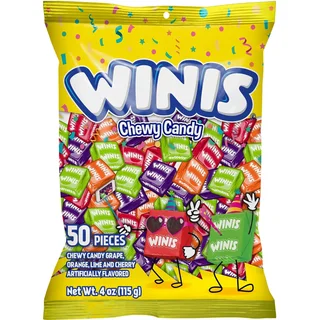
Chewy candy
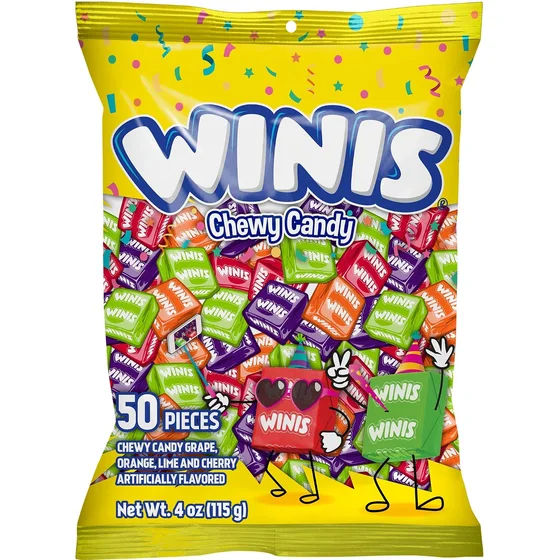
The label with the most pieces in a serving: 13 small wrapped squares in 30 g.
4.0 out of 5 · 2,496 ratings
from $4.75
See This Bag on AmazonThat matters the moment you compare two bags. A serving of Original has 120 calories and a serving of sticks has 140. The gap looks small. Then you notice that one serving is 13 little squares and the other is 3 long sticks.
So the first habit is simple. Read the serving line out loud, pieces and grams together, before you look at anything else. Every comparison that follows will make sense only if you know what each serving holds.
2Pieces, grams and the size of one candy
Divide the serving weight by the piece count and you get the weight of one candy. It is the quickest way to picture a serving on the table, and it needs nothing but the panel.
| Candy | Serving on the label | Weight of one piece | Pieces in one bag | Servings in that bag, by piece count |
|---|---|---|---|---|
| Original Chewy Candy | 13 pieces (30 g) | About 2.3 g | 50 in the 4 oz bag | About 3.8 |
| Unicorn Chewy Candy Sticks | 3 pieces (33 g) | 11 g | 11 in the 4.3 oz bag | About 3.7 |
| Unicorn Chewy Taffy Pops | 4 pieces (30 g) | 7.5 g | 15 in the 4.3 oz bag | About 3.8 |
| Acid Up Sour & Spicy Chewy Candy | 10 pieces (30 g) | About 3 g | 30 in the 4 oz bag | 3 |
An Original square weighs about 2.3 g, which is 30 g over 13 pieces. An Acid Up roll weighs about 3 g, or 30 g over 10. A Unicorn pop weighs 7.5 g, or 30 g over 4. A Unicorn stick weighs 11 g, and its label says so outright: 0.39 oz, or 11 g, a stick.
So one stick weighs almost as much as five Original squares. Two candies that both say chewy on the front can differ almost fivefold in size. A bowl that holds the same number of pieces can hold far more candy or far less.
The check works on any candy whose serving is given in pieces. Grams over pieces gives you one candy, and one candy is the unit a kid actually holds. A parent sorting a party bowl thinks in pieces, and the panel thinks in grams. The division links the two.

The front of the bag works in ounces, and the panel works in grams. A 4 oz bag of Original holds 50 squares. A 4.3 oz bag holds 11 sticks or 15 pops. Bags of nearly the same weight can hold 11 pieces or 50.
Small pieces have a practical side. A serving of 13 Original squares is easy to split between a few kids on the couch. A serving of 3 sticks is not. A stick is one long piece, and it does not split well into a small goodie bag. Pops sit in the middle: 7.5 g each, on a stick, easy to hand out one at a time.
| Battery | Pack | Pieces | Price | Per piece |
|---|---|---|---|---|
| Original Chewy Candy | 2 bags of 150, 300 pieces | 300 | $15.62 | 5¢ |
| Original Chewy Candy | 150 pieces, 12 oz | 150 | $8.00 | 5¢ |
| Original Chewy Candy | 2 bags of 50, 100 pieces | 100 | $9.04 | 9¢ |
| Original Chewy Candy | 50 pieces, 4 oz | 50 | $4.75 | 10¢ |
| Winis Mix Variety Bag | 150 pieces, 3.6 lb | 150 | $17.57 | 12¢ |
| Acid Up Sour & Spicy Chewy Candy | 2 bags of 30, 60 pieces | 60 | $10.47 | 17¢ |
| Unicorn Chewy Taffy Pops | 2 bags, 30 pieces | 30 | $8.74 | 29¢ |
| Unicorn Chewy Taffy Pops | 1 bag, 15 pieces | 15 | $4.59 | 31¢ |
| Unicorn Chewy Candy Sticks | 1 bag, 11 pieces | 11 | $4.80 | 44¢ |
| Unicorn Chewy Candy Sticks | 5 bags, 55 pieces | 55 | $24.00 | 44¢ |
Price follows the same logic as the panel. A bag price alone says little when one bag holds 11 pieces and another holds 150. Per piece, Winis packs run from 5¢ to 44¢. Original Chewy Candy starts at 5¢ a piece, and Unicorn Chewy Candy Sticks starts at 44¢.
For whole-bag math at a party, the party candy guide counts pieces per guest.
3Calories per serving and per piece
Calories sit in large type right under the serving line. On the four Winis panels they run from 100 to 140 per serving. Read alone, that range says little, since the servings hold such different piece counts.
| Candy | Calories per serving | Pieces per serving | Calories per piece |
|---|---|---|---|
| Original Chewy Candy | 120 | 13 | About 9 |
| Unicorn Chewy Candy Sticks | 140 | 3 | About 47 |
| Unicorn Chewy Taffy Pops | 120 | 4 | 30 |
| Acid Up Sour & Spicy Chewy Candy | 100 | 10 | 10 |
Per-piece math fixes that. You take the calories and divide by the pieces in a serving. The label gives you both numbers, so you need no other source and no app.
- Find the serving line and note the piece count.
- Find the calories for that serving.
- Divide the calories by the pieces.
- Multiply by the number of pieces you have in mind, if you want a total.
Two things stand out. One stick carries about as many calories as five Original squares, which matches its weight. And per gram, three of the four candies land on almost the same number: about 4 calories a gram for Original, the sticks and the pops.
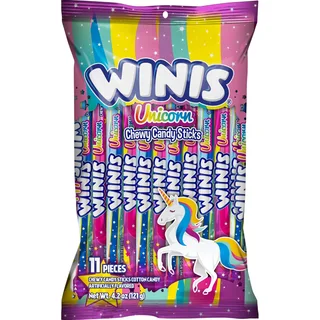
Unicorn
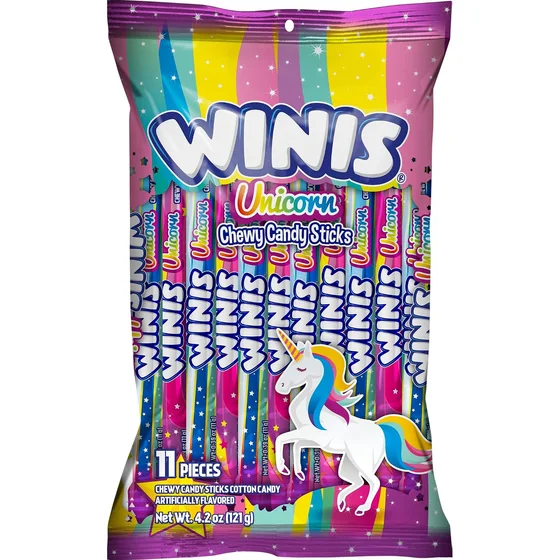
The biggest single piece on the four labels: one 11 g stick at about 47 calories.
4.2 out of 5 · 3,431 ratings
from $4.80
See This Bag on AmazonAcid Up is the exception at about 3.3 calories a gram. Its serving weighs the same 30 g as Original but lists 100 calories instead of 120. The panel gives the totals, not the reason, so the gap is a number to note, not a story to fill in.
Label numbers are rounded, so per-piece figures come out close, not exact. Read about 9 as about 9. For comparing bags, that is all the precision you need.
A per-piece figure also travels well. Once you know a stick is about 47 calories, you can work out any number of sticks without turning the bag over again. The same goes for an Original square at about 9.
| Per piece | Original | Unicorn Sticks | Unicorn Pops | Acid Up |
|---|---|---|---|---|
| Weight | About 2.3 g | 11 g | 7.5 g | About 3 g |
| Calories | About 9 | About 47 | 30 | 10 |
| Added sugars | About 1.8 g | About 7.7 g | About 5.3 g | 1.4 g |
| Share of the 50 g added sugars Daily Value | About 3.5% | About 15% | About 10.5% | About 2.8% |
| Calories per gram | 4 | About 4.2 | 4 | About 3.3 |
| Better choice when | You split candy into many small bags | You want one long stick per guest | A kid wants candy on a stick | The eater likes sour and chili heat |
The same math scales up to a whole bag. Count the pieces, multiply by the per-piece figure, and you have the bag total without guessing at servings. For the 50-piece Original bag, that means 50 squares at about 9.2 calories each.
| Bag | Pieces | Calories in the bag | Added sugars in the bag |
|---|---|---|---|
| Original Chewy Candy, 4 oz | 50 | About 460 | About 88 g |
| Unicorn Chewy Candy Sticks, 4.3 oz | 11 | About 510 | About 84 g |
| Unicorn Chewy Taffy Pops, 4.3 oz | 15 | 450 | About 79 g |
| Acid Up Sour & Spicy Chewy Candy, 4 oz | 30 | 300 | 42 g |
4Total sugars, added sugars and the 50 g Daily Value
Under Total Carbohydrate the panel has two sugar lines. Total Sugars counts all the sugar in a serving. The indented line, Includes Added Sugars, counts the part of that sugar that went in during making.
Only the second line gets a percent. The FDA explains why the first one goes without: There is no Daily Value* for total sugars because no recommendation has been made for the total amount to eat in a day.
U.S. FDA
Added sugars do have a Daily Value, and the FDA gives the number: The Daily Value for added sugars is 50 grams per day based on a 2,000 calorie daily diet.
U.S. FDA Every added sugars percent on a U.S. panel is measured against that 50 g.
| Candy | Total sugars per serving | Added sugars per serving | Added sugars, % Daily Value | Added sugars per piece |
|---|---|---|---|---|
| Original Chewy Candy | 23 g | 23 g | 46% | About 1.8 g |
| Unicorn Chewy Candy Sticks | 23 g | 23 g | 46% | About 7.7 g |
| Unicorn Chewy Taffy Pops | 21 g | 21 g | 43% | About 5.3 g |
| Acid Up Sour & Spicy Chewy Candy | 14 g | 14 g | 29% | 1.4 g |
On the four Winis panels, total and added sugars match gram for gram. Original and the sticks each show 23 g. The pops show 21 g and Acid Up shows 14 g. When the two lines match, all the sugar in a serving counts as added.
You can check the percent column yourself. 23 g is 46% of 50 g, so Original and the sticks come out even. For the pops and Acid Up your own division lands one point under the panel, at 42% and 28%. A one-point gap like that comes from rounding, and the panel’s figure is the one to go by.
Per piece, the numbers spread out. An Original square holds about 1.8 g of added sugars, about 3.5% of the Daily Value. A Unicorn stick holds about 7.7 g, about 15%. The serving line hides that spread, and the per-piece math brings it back.
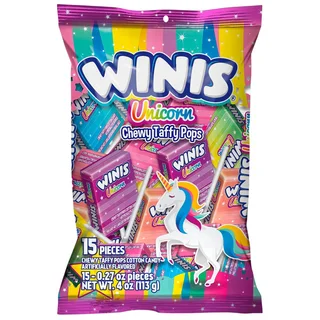
Unicorn
Four pops make a serving, and the label shows 21 g of added sugars, 43% of the Daily Value.
4.2 out of 5 · 286 ratings
from $4.59
See This Bag on AmazonOne group sits outside this math altogether. The CDC’s page on feeding infants and toddlers puts it plainly: Foods with added sugars, low-calorie sweeteners, or no-calorie sweeteners are not recommended for infants and young children.
CDC The 50 g figure rests on a 2,000 calorie day, as the FDA line says, so a parent of a toddler reads the CDC line first.
5The 5% and 20% rule of thumb
The % Daily Value column on the right is the fastest way to read any panel. You do not need to know how many grams of fat or sugar fit in a day. You only need two lines to hold each percent against.
The FDA gives a low line, 5% DV or less of a nutrient per serving is considered low
U.S. FDA, and a high line, 20% DV or more of a nutrient per serving is considered high
U.S. FDA. Everything between the two is in the middle. That is the whole rule.
| Line on the panel | Original | Unicorn Sticks | Unicorn Pops | Acid Up |
|---|---|---|---|---|
| Calories | 120 | 140 | 120 | 100 |
| Total Fat | 1 g, 2% | 1.5 g, 2% | 1 g, 1% | 1 g, 2% |
| Saturated Fat | 0.5 g, 3% | 0.5 g, 4% | 0.5 g, 3% | 0.5 g, 3% |
| Sodium | 0 mg, 0% | 0 mg, 0% | 0 mg, 0% | 140 mg, 6% |
| Total Carbohydrate | 27 g, 10% | 31 g, 11% | 27 g, 10% | 23 g, 8% |
| Added Sugars | 23 g, 46% | 23 g, 46% | 21 g, 43% | 14 g, 29% |
Read across and the panel sorts itself. Fat and saturated fat sit at 4% or under on every bag, under the FDA’s 5% line. Sodium sits at 0% on three bags and 6% on Acid Up. Total carbohydrate lands in the middle, from 8% to 11%.
Added sugars sit well above the 20% line on all four bags, from 29% for Acid Up to 46% for Original and the sticks. For candy that will surprise no one. The panel does not judge a food. It puts every line on the same scale, so a bag of chews can be read next to anything else in the pantry.
| Where the percent falls | Lines on the four Winis labels |
|---|---|
| 5% or less, which the FDA calls low | Total fat, saturated fat and cholesterol on all four. Sodium on Original, the sticks and the pops. |
| Between 5% and 20% | Total carbohydrate on all four, from 8% to 11%. Sodium on Acid Up, at 6%. |
| 20% or more, which the FDA calls high | Added sugars on all four, from 29% to 46%. |
Dietary fiber reads 0 g and 0% on all four labels. Protein reads 0 g. Trans fat and cholesterol read 0 as well. Those rows are short reads, and you can move past them.
The rule works the same way across brands and across aisles. Hold a bag of Winis Original and a bag of crackers side by side, and the same two lines tell you where each sits on each row. The grams will differ in size. The 5% and 20% lines stay put.
6Where the Acid Up label reads differently
Put the four panels side by side and one breaks the pattern. Acid Up lists 140 mg of sodium per serving, 6% of the Daily Value. The other three show 0 mg.
| Line | Original Chewy Candy | Acid Up Sour & Spicy Chewy Candy |
|---|---|---|
| Serving | 13 pieces (30 g) | 10 pieces (30 g) |
| Calories per serving | 120 | 100 |
| Sodium per serving | 0 mg, 0% | 140 mg, 6% |
| Added sugars per serving | 23 g, 46% | 14 g, 29% |
| Flavors on the pack | Grape, orange, lime and cherry | Pineapple, orange and cherry with chili |
| Allergen named on the product page | Soy | Soy |
| Better choice when | The eater wants plain fruit flavors | The eater likes sour and chili heat |
The panel does not say where that sodium comes from. It gives the amount and the percent, and that is all a reader can take from it. At 6% it sits just above the FDA’s 5% line and far under the 20% line.
Acid Up also has the lowest calories and added sugars per serving of the four: 100 calories and 14 g. Per piece the gap with Original shrinks. An Acid Up roll comes to 10 calories and 1.4 g of added sugars. An Original square comes to about 9 calories and 1.8 g.
Flavor is the other thing a panel cannot show. Acid Up is pineapple, orange and cherry with chili, artificially flavored. A kid who hates any heat will not enjoy it, whatever the numbers say. The word chili in the name is the warning, and the panel stays silent on taste.
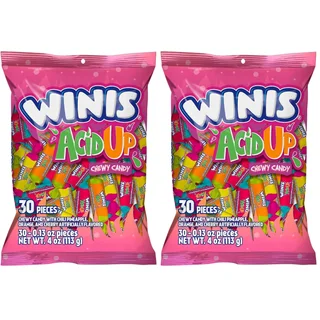
Sour & spicy
Acid Up Sour & Spicy Chewy Candy
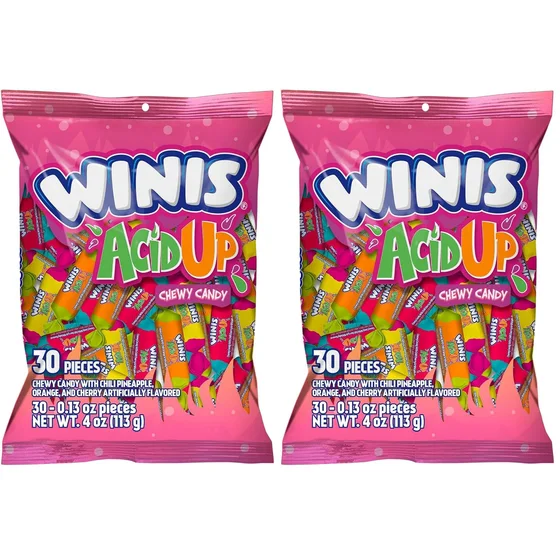
The one Winis label with sodium on it: 140 mg, 6% of the Daily Value, in a 10-piece serving.
3.8 out of 5 · 272 ratings
$10.47
See This Bag on AmazonSo the lower numbers are no reason on their own to swap one bag for the other. A label tells you how much. It does not tell you whether the person holding the candy will like it.
7A worked example: one game-night bowl
Say a host fills one bowl for a game night with 26 Original squares, a 15-piece bag of Unicorn pops and an 11-piece bag of Unicorn sticks. That makes 52 wrapped pieces in three shapes. The three labels are enough to put numbers on the whole bowl.
The 26 squares are exactly two Original servings, so 240 calories and 46 g of added sugars. The 15 pops come to 450 calories and about 79 g. The 11 sticks come to about 510 calories and about 84 g. Together the bowl holds about 1,200 calories and about 209 g of added sugars.
| In the bowl | Pieces | Calories | Added sugars |
|---|---|---|---|
| Original squares | 26 | 240 | 46 g |
| Unicorn pops | 15 | 450 | About 79 g |
| Unicorn sticks | 11 | About 510 | About 84 g |
| Whole bowl | 52 | About 1,200 | About 209 g |
What the labels cannot say is how the bowl empties. Four friends may take a handful each or forget it for an hour. The math gives you the size of the bowl, not the shape of the evening.
8The allergen line and the nine major allergens
Allergens are a separate read from the numbers. The FDA explains where the federal list started: While many different foods can cause allergic reactions, the Food Allergen Labeling and Consumer Protection Act of 2004 (FALCPA) identified eight foods as major food allergens: milk, eggs, fish, Crustacean shellfish, tree nuts, peanuts, wheat, and soybeans.
U.S. FDA
A later law added one more: On April 23, 2021, the Food Allergy Safety, Treatment, Education, and Research (FASTER) Act was signed into law, declaring sesame as the 9th major food allergen recognized by the United States.
U.S. FDA That brings the federal list to nine.
| Major allergen | On the federal list since | What the Winis product pages say |
|---|---|---|
| Peanuts | 2004 (FALCPA) | No peanuts, on every Winis product page |
| Tree nuts | 2004 (FALCPA) | No tree nuts, on every Winis product page |
| Soybeans | 2004 (FALCPA) | Soy named for Original Chewy Candy and Acid Up |
| Milk | 2004 (FALCPA) | Read the Contains line on the bag |
| Eggs | 2004 (FALCPA) | Read the Contains line on the bag |
| Wheat | 2004 (FALCPA) | Read the Contains line on the bag |
| Fish | 2004 (FALCPA) | Read the Contains line on the bag |
| Crustacean shellfish | 2004 (FALCPA) | Read the Contains line on the bag |
| Sesame | 2021 (FASTER Act) | Read the Contains line on the bag |
The usual form on a pack is a short Contains line. The FDA’s own example shows the format: Example: “Contains Wheat, Milk, and Soy.”
U.S. FDA Short, plain and easy to find, once you know to look for it.
Here is what the Winis product pages say. The pages for Original Chewy Candy and Acid Up name soy. Each of the five Winis product pages says the candy has no high-fructose corn syrup, peanuts or tree nuts. That covers Original, the Unicorn sticks and pops, Acid Up and the Mix party bag.
The Unicorn sticks and pops pages name no allergen at all. That gap is not the same as a statement that the candy has none. A reader with a soy, milk or wheat allergy gets the answer from the Contains line on the bag, not from a product page.

Mixed bowls bring one more catch. Once candies leave their bags, the Contains lines stay behind. A host who pours three kinds into one bowl can keep the empty bags nearby, so a parent can check the wrappers against the labels. More common questions sit on the Winis questions page.
9What the panel does not tell you
A Nutrition Facts panel is a box of numbers. It carries no ingredient list, and the ingredient list is where an allergic reader finds the detail. The Winis panels say nothing about ingredients, so a reader with an allergy should read the ingredient list on the bag in hand.
| Question | Where on the bag | Winis example |
|---|---|---|
| How much is one serving? | Serving size, at the top of the panel | Original: 13 pieces (30 g) |
| How many calories in a serving? | Calories, in large type under the serving line | Unicorn Sticks: 140 |
| How much added sugar? | Includes Added Sugars, under Total Sugars | Acid Up: 14 g, 29% of the Daily Value |
| Is there sodium? | Sodium, between cholesterol and carbohydrate | Acid Up: 140 mg, 6% of the Daily Value |
| Which major allergens? | The Contains line | Original and Acid Up: soy, per the product pages |
| Peanuts or tree nuts? | The Contains line | No peanuts or tree nuts, per every Winis product page |
The panel also skips the things most buyers ask about. It gives no flavors, colors or shapes. It does not say how chewy a candy is, or how long a bag keeps. Those answers come from the front of the pack and from the product pages.
The panel says nothing about wrappers either. Original, the Unicorn sticks and pops, Acid Up and the Mix all come individually wrapped, and at a shared bowl that fact matters more than any number on the back.
Labels also change over time. A recipe or a bag size can change, and the panel changes with it. The bag in your hand outranks any number copied from it, including any number you read online.
| What you want to know | On the Nutrition Facts panel? | Where to look |
|---|---|---|
| Serving size and servings per bag | Yes | The top of the panel |
| Calories, sugars, fat and sodium | Yes | The body of the panel |
| Ingredients | No | The ingredient list on the bag |
| Major allergens | No | The Contains line on the bag |
| Flavors | No | The candy’s name and the front of the pack |
| Wrapping | No | The front of the pack and the product page |
The Winis Mix Variety Bag is the odd one out. It holds taffy pops, sticks and minis in grape, cherry, raspberry, apple, strawberry and surprise flavors, and its product page shows no Nutrition Facts panel. The numbers come off the bag you hold. The surprise flavors also mean a picky eater cannot pick one ahead of time.
A one-minute read of any candy bag
- Read the serving line: pieces and grams together.
- Divide calories by pieces to get a per-piece number.
- Check added sugars against the 50 g Daily Value, and hold every percent against the 5% and 20% lines.
- Glance at sodium and fat, where one bag can differ from the rest, as Acid Up does on sodium.
- Read the Contains line, then the ingredient list, if anyone at the table has an allergy.
- Compare bags per piece, not per serving.
That is the whole routine. It takes a minute the first time and a few seconds after that. The guide to Winis formats covers the bags themselves.
Shop the candy
Candies from the worked examples
-
 Chewy candy
Original Chewy Candy
50, 100, 150 or 300 pieces a pack · 120 cal per 13 pieces
4.0 out of 5 · 2,496 ratings
from $4.755¢ a piece in 2 bags of 150
Grab a Bag on Amazon -
 Unicorn
 Chewy Candy Sticks
11 or 55 pieces a pack · 140 cal per 3 pieces
4.2 out of 5 · 3,431 ratings
from $4.8044¢ a piece in 1 bag
Grab a Bag on Amazon -
 Sour & spicy
Acid Up Sour & Spicy Chewy Candy
60 pieces a pack · 100 cal per 10 pieces
3.8 out of 5 · 272 ratings
$10.4717¢ a piece in 2 bags of 30
Grab a Bag on Amazon
Questions
Label questions
How many calories are in one Winis Unicorn stick?
About 47. One Unicorn Chewy Candy Sticks serving of 3 pieces (33 g) has 140 calories, so a single stick comes to a third of that.
Why is a serving 13 pieces of Original but only 3 Unicorn sticks?
The serving is close to 30 g on both bags: 13 small Original squares weigh 30 g, while 3 Unicorn sticks weigh 33 g at 11 g a stick.
Which Winis candies name soy as an allergen?
Original Chewy Candy and Acid Up Sour & Spicy Chewy Candy, 2 of the 5 Winis candies, name soy on their product pages. Soy is one of the 9 major food allergens in the U.S.
Sources
Sources
- How to Understand and Use the Nutrition Facts LabelU.S. FDA · read October 21, 2026
- Added Sugars on the Nutrition Facts LabelU.S. FDA · read October 21, 2026
- Choking Hazards, Infant and Toddler NutritionCDC · read October 21, 2026
- Food Allergies: What You Need to KnowU.S. FDA · read October 21, 2026
Keep reading
More from the candy blog
- Party planningHow much candy for a piñata, goodie bags and a party tablePieces per guest for a piñata, goodie bags, a class share and Halloween.
- Formats guideCubes, sticks, pops or chili chews: picking a Winis format to shareCubes, sticks, pops, chili chews or a mixed bag: which Winis shape suits your crowd.